How to Learn English Effectively When You're Busy
Busy adults don't need twelve apps. Here's a realistic English system: daily speaking, phrase learning, the 'Where am I?' drill, and feedback that sticks.
If you're busy, you don't need twelve new apps. You need a small system you can repeat on a workday without heroics.
Short answer: learn English effectively by speaking a little every day about your real life and job, fixing one habit at a time, and using input (reading, podcasts, AI) as fuel — not as a substitute for speaking.
Why most busy-adult plans fail
- Too much grammar, not enough production
- Streaks that reward opening an app, not saying a sentence
- Weekend cramming that disappears by Tuesday
- Perfect AI emails beside frozen Zoom calls
Real progress is when people understand you in real conversations and you feel in control.
A practical system that fits a full-time job
1. Micro-practice beats rare marathons
Ten to fifteen minutes daily outperforms a Sunday guilt session.
2. Habit-stack into what you already do
Commute, coffee, inbox zero — attach English to an existing routine.
3. Think in English for small moments
Narrate: "I'm sending the file… I need a clearer subject line." Translation delay shrinks with use.
4. Learn phrases, not isolated words
"I'm running late because of traffic" travels farther than the word traffic alone.
5. My favourite drill: "Where am I?"
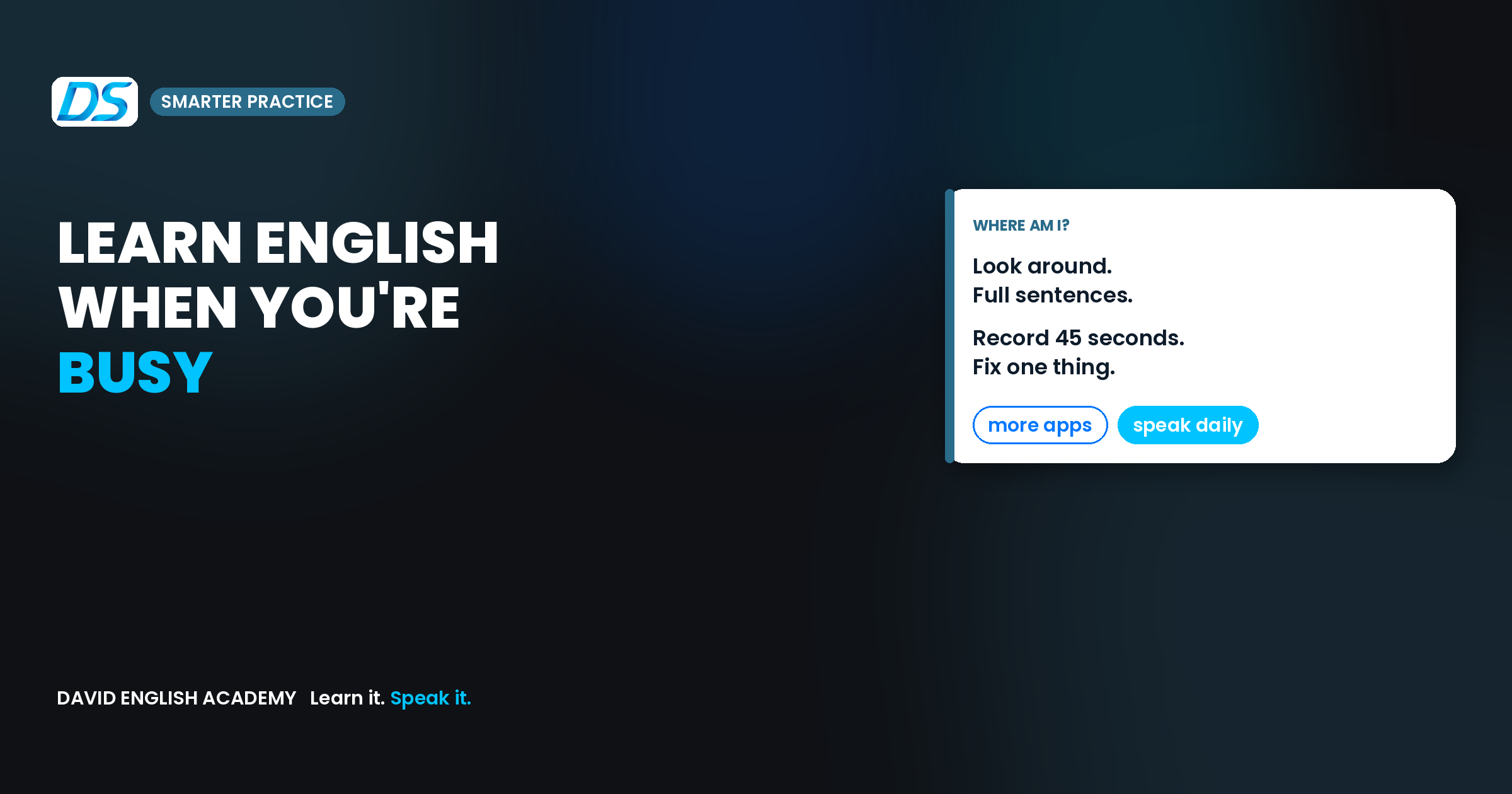
Wherever you are, ask out loud: "Where am I right now?" Answer in full sentences with prepositions: in, on, next to, behind, between. Record 30–60 seconds on your phone. It's simple, private and brutally effective for speaking fluency.
6. Review like a coach
Watch the recording once. Choose one fix. Record again.
7. Role-play before real events
Interview, demo, escalation — practise the conversation before you're in it.
8. Use AI as a gym, people as the match
Draft or role-play with AI, then say it to a human. (More on that in my ChatGPT post.)
9. Practise the English of your job
Meetings, Zoom, email, interviews. If you'll never say it, don't drill it.
10. Track proof, not vibes
Save one speaking sample every two weeks. Compare. Celebrate a clearer opener or a faster answer — not a perfect accent.
What to ignore in 2026
- Anyone selling fluency in seven days
- Advice that never asks you to speak
- Giant vocabulary decks with no sentences
- Guilt when you miss a day — restart the next morning
You're building a professional skill. Treat it like training for work, not like a personality makeover.
A five-day starter (copy this)
| Day | Task (10–15 min) |
|---|---|
| Mon | "Where am I?" + one work goal |
| Tue | Podcast summary out loud |
| Wed | Read one work email → spoken paraphrase |
| Thu | Role-play tomorrow's hardest English moment |
| Fri | Re-record Monday's answer; note one improvement |
Do this for four weeks before you buy another course you won't open.
How I teach this
At David English Academy, the method is consistent: speak from day one; choose the word that fits the situation, then the form and structure; correct, coach and build; finish with a "Your turn" prompt. Short timed speaking turns (the JAM method) train you under a clock. Born and raised in New York, I've been teaching English since 2011 — online with professionals worldwide — and this is still the pattern that works for busy adults.
Mini exercise (tonight): Do one "Where am I?" recording (45 seconds). Then add 30 seconds: What's the most important task on your plate tomorrow?
Your turn: Pick one strategy from this post and put it in your calendar for the next five workdays — same time, same length.
Frequently asked questions
How long does it take to notice progress?
With daily speaking, many learners feel a difference within a few weeks. The calendar matters less than whether speaking became a habit.
Do I still need grammar study in 2026?
Yes — in small doses tied to mistakes you actually make while speaking. Grammar as an endless separate subject is how people stall.
What's the one thing to do if I only have ten minutes?
Speak. A timed answer about your day beats ten silent minutes of scrolling "English tips."
Read next
- How Can I Get Fluent in English Fast? An Honest Answer
- ChatGPT vs Real Conversation: How to Use AI Without Killing Your Speaking
I'm David Sugarman, founder of David English Academy. Born and raised in New York, I've been teaching English since 2011, and today I teach professionals online around the world. Learn it. Speak it. Read more about me, or visit the homepage to explore the courses.