Business Books That Improve Your English (And How to Use Them)
Business books can upgrade your English — if you speak about what you read. Here's my method, plus a practical reading list for professionals.
Reading business books in English is one of the smartest habits for professionals — if you use the book as speaking fuel, not as silent decoration on a shelf.
Short answer: yes, the right business books improve your English. They give you the vocabulary of strategy, product, leadership and decisions. They only change your meetings when you practise saying the ideas out loud.
How to read a business book for English (my method)
- Read a short section (not a marathon chapter if you're tired).
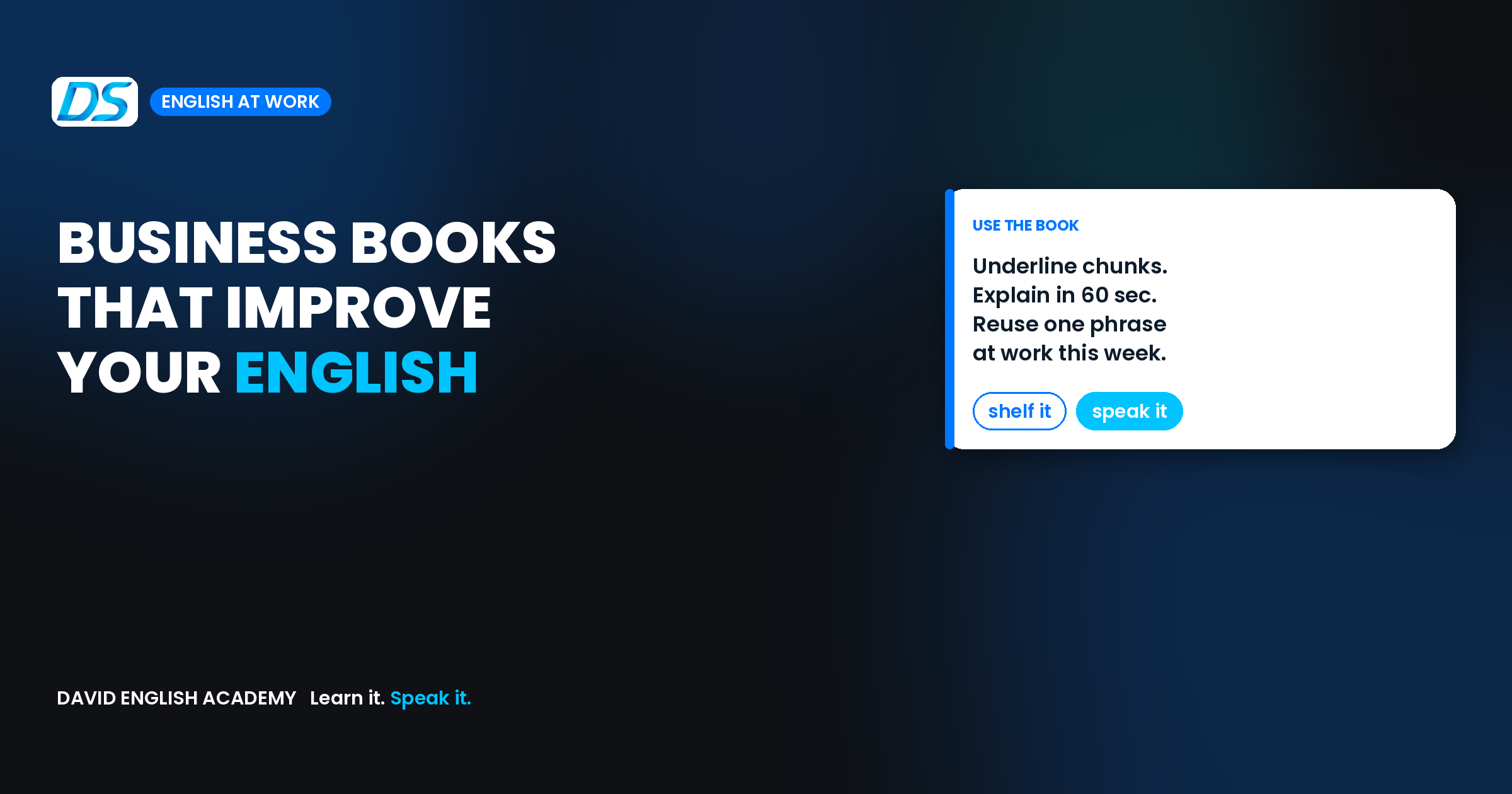
- Underline chunks, not single words: "the real bottleneck is…", "what gets measured gets managed."
- Write three lines in your own words.
- Speak for 60 seconds: explain the idea to an imaginary colleague.
- Reuse one phrase in a real email or standup that week.
That's choose-the-word-then-use-it. No robotic chapter summaries nobody asked for.
Books I actually point busy students toward
I'm not ranking a scientific "top 10." These are widely known titles that work well for intermediate+ learners because the ideas are useful and the language shows up at work. Pick one, finish it slowly, speak about it.
-
Atomic Habits — James Clear
Clear language about systems vs goals. Great for practising advice phrases: "make it obvious", "make it easy." -
The Lean Startup — Eric Ries
Product and experiment vocabulary: pivot, MVP, validated learning. Ideal if you work in tech. -
Thinking, Fast and Slow — Daniel Kahneman
Harder linguistically, excellent ideas. Read short sections. Practise explaining one bias in simple English. -
Good to Great — Jim Collins
Classic company language: discipline, culture, confront the brutal facts. -
Start with Why — Simon Sinek
Helpful for presentations: purpose before features. Practise a 60-second "why" for your product. -
Dare to Lead — Brené Brown
Language for feedback, trust and tough conversations — useful in management English. -
The Innovator's Dilemma — Clayton Christensen
Disruption vocabulary for strategy discussions. Dense; use chapter summaries + spoken paraphrase. -
The 7 Habits of Highly Effective People — Stephen Covey
Older classic; still everywhere in corporate training. Good practice for explaining frameworks simply. -
Deep Work — Cal Newport (my swap for trendier "hustle" books)
Focus and attention language for modern teams. Clearer payoff than most "crush it" titles. -
A book from your own industry
The tenth "book" should be yours: an engineering, finance, aviation or healthcare title you'll actually discuss with colleagues.
(If you love a different classic, use it. The method matters more than my list.)
What to do when the book is too hard
Some titles are linguistically heavy. That's OK.
- Read the chapter summary first (official or your own)
- Learn five chunks
- Speak the idea in simpler English than the author used
- Come back to the dense paragraphs later
Understanding every adjective is not the goal. Being able to explain the idea to your manager is.
How I teach with business reading
You speak from day one. We take a real idea from a page — a risk, a metric, a customer problem — and you choose the word that fits your situation, then the structure. I correct, coach and build. Short timed speaking turns (the JAM method) turn "I read it" into "I can explain it on Zoom."
Mini exercise: Open any business book or article on your desk. Steal one sentence. Close it. Set 45 seconds. Explain the idea in simpler English, as if your manager asked, "So what?"
Your turn: This week, bring one phrase from your reading into a real standup or email — then notice whether anyone understood you faster.
Frequently asked questions
What level do I need to read business books in English?
If you can follow a news article about your industry, you can start. Use a dictionary for key words, not for every adjective.
Is listening to the audiobook as good as reading?
Audiobooks train the ear; text makes it easier to capture phrases. Best combo: listen on the commute, then speak a summary; skim the text for chunks you want to reuse.
Should I translate every unknown word?
No. Translate the words that block the main idea. Keep moving. Fluency comes from using language, not from perfect glossaries.
Read next
- How to Learn English Effectively When You're Busy
- Reading vs Listening: What Actually Helps You Speak English Better?
I'm David Sugarman, founder of David English Academy. Born and raised in New York, I've been teaching English since 2011, and today I teach professionals online around the world. Learn it. Speak it. Read more about me, or visit the homepage to explore the courses.