How Can I Get Fluent in English Fast? An Honest Answer
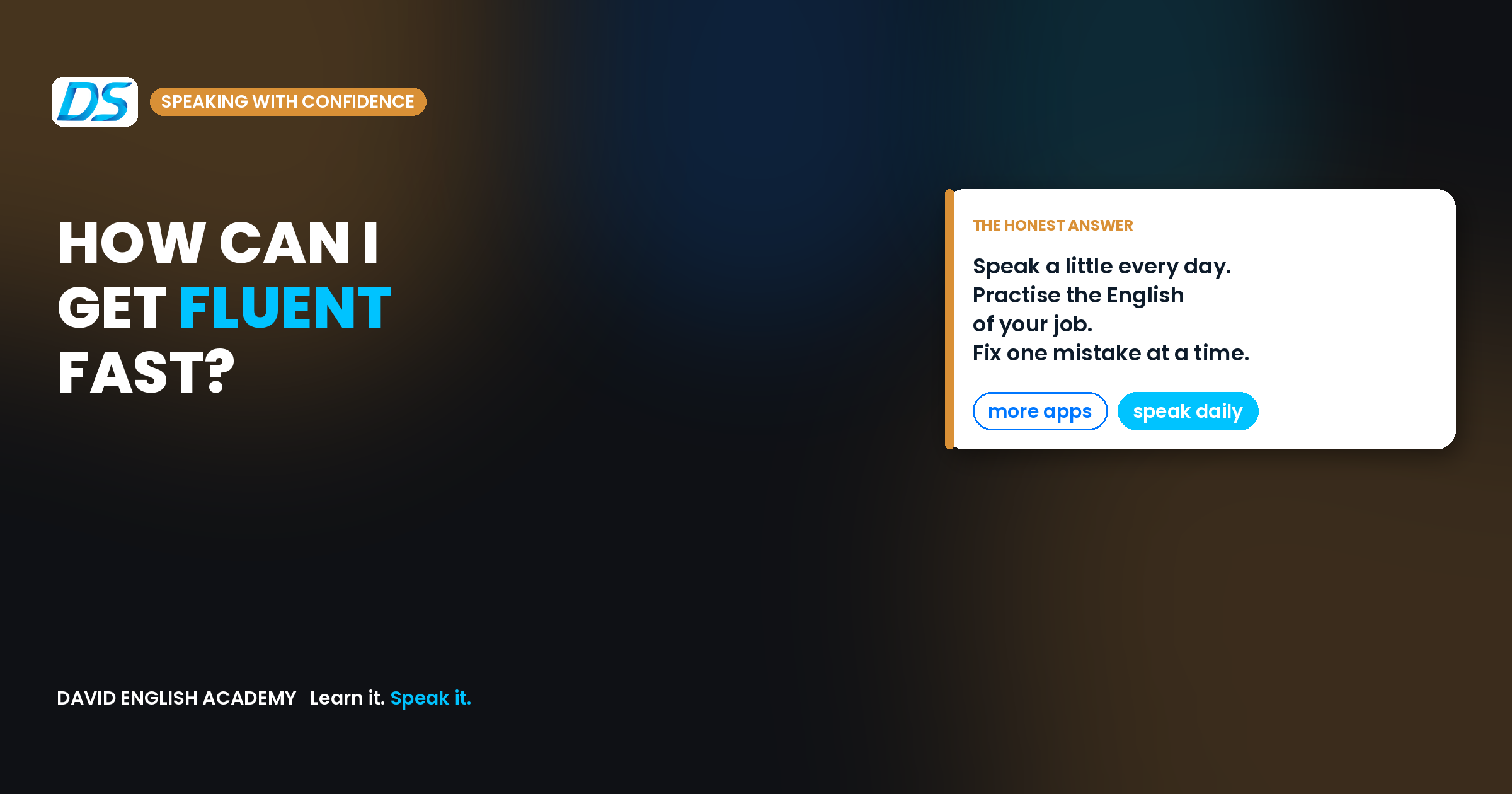
Want fluent English fast? Here's an honest plan: speak every day, practise the English of your job, and fix one mistake at a time.
Everyone wants the same thing: "David, how can I get fluent fast?" I get it. You're busy. You don't want a five-year plan. You want to stop freezing on Zoom, stop second-guessing every sentence, and feel in control of your English at work.
I'll give you an honest answer. Not the Instagram answer.
The short answer
You can get noticeably more fluent in weeks, if you practise speaking in real situations every day. You cannot become "fluent forever" in two weeks. Fluency is a habit, not a download. The people who improve fast don't study more. They speak earlier, they make fewer of the same mistakes, and they practise the English they'll actually need on Monday morning.
What "fluent" really means (and what it doesn't)
When most people say "fluent", they mean one of these:
- I can join a meeting without avoiding the call.
- People understand me the first time.
- I can write my own emails.
- I don't feel confused every time someone asks me a question.
That's a good goal. That's also reachable. What "fluent" does not mean is "I sound like a native speaker and never make a mistake." Even native speakers make mistakes. What matters is that people understand you, and that you feel in control.
Why most "get fluent fast" advice fails
You've probably already tried some of this:
- Watching more videos
- A streak on a language app
- Memorising word lists
- Waiting until you "know enough grammar"
Those can help a little. They rarely change what happens when someone turns to you and says, "What's your take?" Because they don't train the skill you need: choosing your words, in real time, about your real life.
Apps and videos keep you in the passenger seat. Fluency comes when you drive.
My take: real progress, not theory
At David English Academy, the method is simple: you speak from day one. We correct, coach and build you up lesson by lesson. Not in theory. In real conversations about your job, your week, your opinions.
If you want to move fast on your own between lessons, use this three-part plan.
1. Speak every day for 5–10 minutes (non-negotiable)
Not "study". Speak. Options that actually work for busy people:
- Leave yourself a voice note about your day.
- Answer three work questions out loud before a meeting.
- Narrate what you're doing while you make coffee: "I'm making coffee. I'm waiting for the water to boil."
Five minutes of speaking beats an hour of scrolling through lessons you'll never use.
2. Practise the English of your job
Don't learn "the restaurant dialogue" if your problem is client calls. Make a short list of situations you face every week:
- Giving a status update
- Asking for more time
- Disagreeing politely
- Explaining a technical problem simply
Write one or two sentences for each. Say them out loud until they feel easy. That's how you stop making the same mistakes in the same situations.
3. Fix one mistake at a time
If you try to fix everything, you fix nothing. Pick one pattern this week. For many learners, it's the present perfect: "I work here five years" → "I've worked here for five years." Catch it, correct it out loud, move on. Next week, pick another.
Mini lesson: choose the word, then the form
Say each answer out loud before you look.
Level 1: A quick update
Your manager asks: "How's the project going?"
Words: finish / work / wait
You're in the middle of it and you'll finish on Friday.
"We're still ___ on it. We should ___ by Friday."
Answer: We're still working on it. We should finish by Friday.
Level 2: Asking for more time
A client wants the report tomorrow. You need until Monday.
Words: need / send / push
"I ___ a bit more time. Can I ___ it over on Monday instead of ___ it tomorrow?"
Answer: I need a bit more time. Can I send it over on Monday instead of pushing it tomorrow? (Or: "...instead of sending it tomorrow." Both work; the point is to ask clearly.)
Better natural version: "I need a bit more time. Can I send it on Monday?"
Level 3: Disagreeing politely
Someone suggests launching next week. You think it's too soon.
Words: feel / wait / risk
"I ___ we should ___ a week. If we launch now, we ___ shipping bugs."
Answer: I feel we should wait a week. If we launch now, we risk shipping bugs.
Your turn
Answer these out loud:
What does "fluent" mean for you, personally? Name one work situation where you want to feel in control of your English. What would you say in that situation, in two or three sentences?
Say it now. That's your first "fast" practice session.
How we make "fast" actually work in lessons
Fast progress isn't more theory. In my lessons you speak from day one about the English of your actual job — meetings, Zoom calls, emails — and we correct, coach and build lesson by lesson. You choose the word that fits the real situation, then the form and structure. Not robotic transformations from a worksheet.
The accelerator is short timed speaking (the JAM method): about 60 seconds on a work prompt, immediate feedback, then a tighter second take. Five good minutes of that beats an hour of scrolling. Between lessons, keep the same habit: speak daily, practise your situations, fix one mistake at a time.
Mini exercise (do this once today): Pick one recurring work moment (status update, asking for time, or disagreeing politely). Timer on: 60 seconds. Say your answer out loud twice — first for clarity, second for control. Note one form you corrected on the second take.
Your turn: Name the work situation where you most want to feel fluent. Speak for 60 seconds as if that meeting started now.
Frequently asked questions
How long does it take to get fluent in English?
If you speak a little every day about real situations, most busy adults notice clearer, more confident English within a few weeks. Full, comfortable fluency takes longer. Measure progress by real moments (meetings, emails, calls), not by a perfect score.
Can I get fluent with apps alone?
Apps help with words and habits. They don't replace speaking in real conversations. Use an app if you like it, then say something out loud about your own life every day.
What's the fastest thing I can do this week?
Pick three questions you often get at work. Write short answers. Say each one out loud twice a day. Do that for seven days. You'll walk into next week's meetings less empty-handed.
Read next
- I Understand English but Can't Speak It. Why, and How to Fix It
- You Know English Grammar. So Why Can't You Use It?
I'm David Sugarman, founder of David English Academy. Born and raised in New York, I've been teaching English since 2011, and today I teach professionals online around the world. Learn it. Speak it. Read more about me, or visit the homepage to explore the courses.