Podcasts for Better English: Listen So You Actually Speak
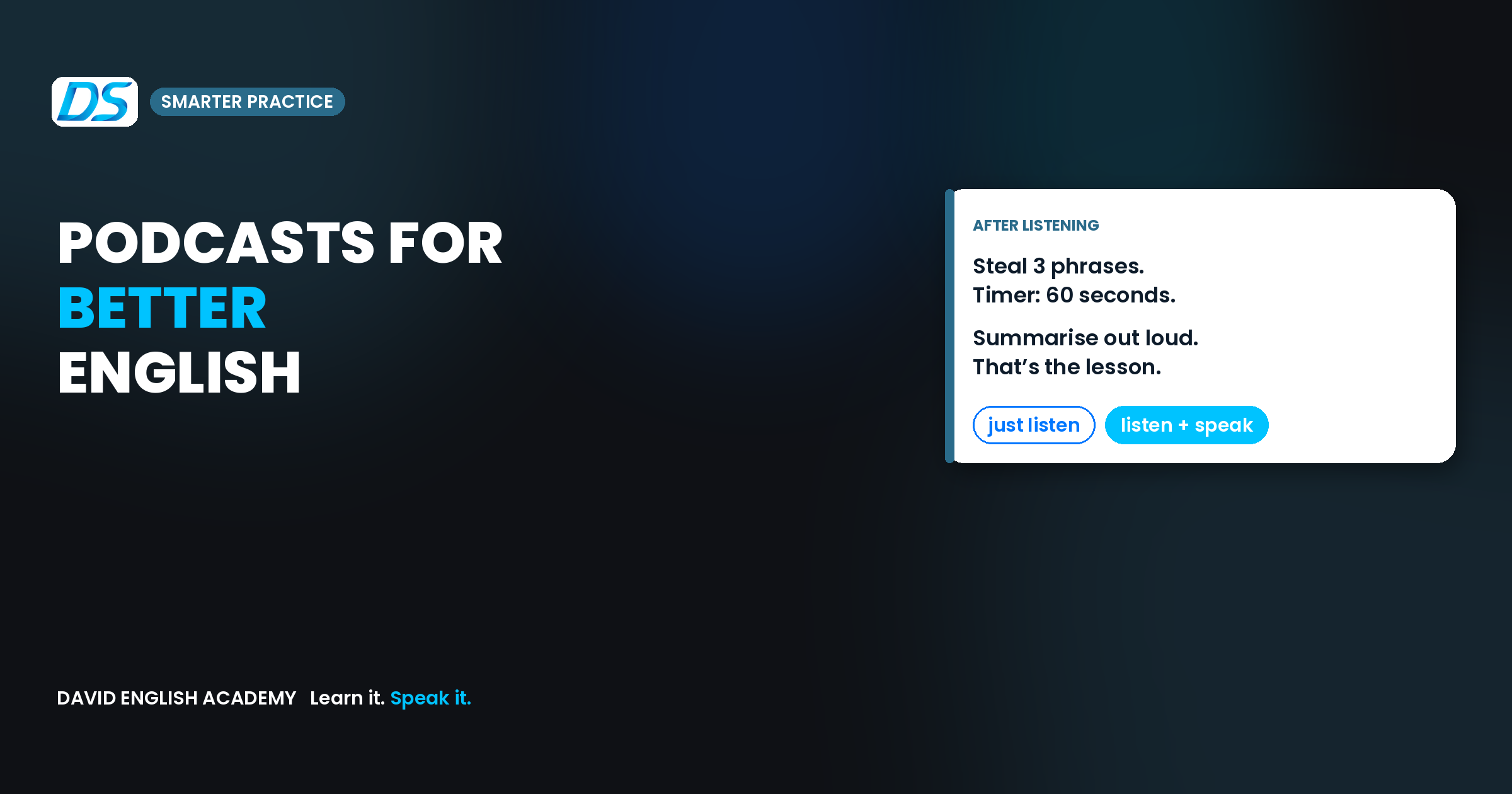
Podcasts build your ear — not automatic fluency. Here's how to listen so you actually speak: steal phrases, summarise out loud, practise under a timer.
Podcasts are one of the easiest ways to get English into a busy day. The mistake I see is treating them like magic: headphones on, fluency off.
Short answer: podcasts build listening and vocabulary. They only help your speaking when you turn what you heard into something you say.
Why podcasts help (and where they stop)
Podcasts give you:
- Natural speed and rhythm
- Real opinions, not textbook dialogues
- Topics you actually care about (so you keep listening)
Podcasts do not automatically:
- Fix the freeze in a meeting
- Correct your repeated grammar mistakes
- Teach you the English of your job
Listening is recognition. Speaking is production. You need both.
How I tell students to use a podcast (10–15 minutes)
- Choose interest over "English learning" labels. If you love startups, listen to a business show. Boredom kills consistency.
- Listen once for meaning. Don't pause every three seconds.
- Steal three phrases — not thirty words. Write chunks: "the big risk is…", "what surprised me was…".
- Speak for 60 seconds. Summarise the episode out loud: what happened, what you think, what you'd ask the guest.
- Optional shadow: replay one short segment and speak with the host for rhythm.
That last speaking step is the difference between "I listened" and "I can use it."
Podcasts worth using (examples, not a sponsored list)
I don't need you on a specific brand. I need you on content you'll finish.
- Story / culture: This American Life — long-form American storytelling; great for rhythm and informal speech
- Your industry podcast — engineering, product, marketing, aviation — so the vocabulary matches your meetings
- News explainers in English — short episodes you can summarise the same day
Skip the guilt if you don't finish a 60-minute episode. A focused 12 minutes plus a spoken summary beats a passive hour.
Make it job-specific
If you work in product, don't only listen to celebrity interviews. Find a show where people argue about roadmaps, metrics and customers. Your future meeting language is hiding there: "adoption", "churn", "trade-off", "rollout."
Same rule for finance, aviation, marketing, HR. Interest keeps you listening. Job relevance makes the phrases reusable on Monday.
Common podcast mistakes (and fixes)
Mistake: binge-listening at 2x speed with zero output.
Fix: half speed of content, full effort on a spoken summary.
Mistake: only "English learner" shows forever.
Fix: graduate to real topics once you catch the main idea.
Mistake: writing huge vocabulary lists you never say.
Fix: three reusable chunks per episode, spoken the same day.
Mistake: passive listening while scrolling.
Fix: headphones + intention: "I will speak for one minute after this."
How I teach with listening
In lessons, listening is fuel for speaking. You speak from day one. We take a short clip or a work-related audio idea, then you choose the word that fits the real situation, then the form. I correct, coach and build. No robotic transformations. Short timed speaking turns (the JAM method) put your summary under a clock — the same pressure you feel when someone asks, "So what did you think?"
Mini exercise: Play any English podcast for five minutes. Pause. Set 60 seconds. Answer out loud: What's the main point, and do you agree? Then say it again in 40 seconds, clearer.
Your turn: After tomorrow's commute listen, send yourself a voice note summarising the episode in English — no script.
Frequently asked questions
Can podcasts make me fluent by themselves?
No. They make you a better listener and give you language to reuse. Fluency needs speaking practice with feedback.
What level do I need before I start?
If you understand the main idea of a short news story, you can start. Use slower playback at first if you need it — then turn the speed back up.
Should I only listen to "learn English" podcasts?
Not only. Learner podcasts can help beginners. Intermediate and advanced professionals usually progress faster with real shows about topics they already know.
Read next
- Reading vs Listening: What Actually Helps You Speak English Better?
- Practical Steps to Think in English (Without Translating First)
I'm David Sugarman, founder of David English Academy. Born and raised in New York, I've been teaching English since 2011, and today I teach professionals online around the world. Learn it. Speak it. Read more about me, or visit the homepage to explore the courses.