Scared of Speaking English? What to Do When You Freeze
You prepare for the Zoom call, then stay on mute. Here's how fear of speaking English works at work — and four small steps that make it safer.
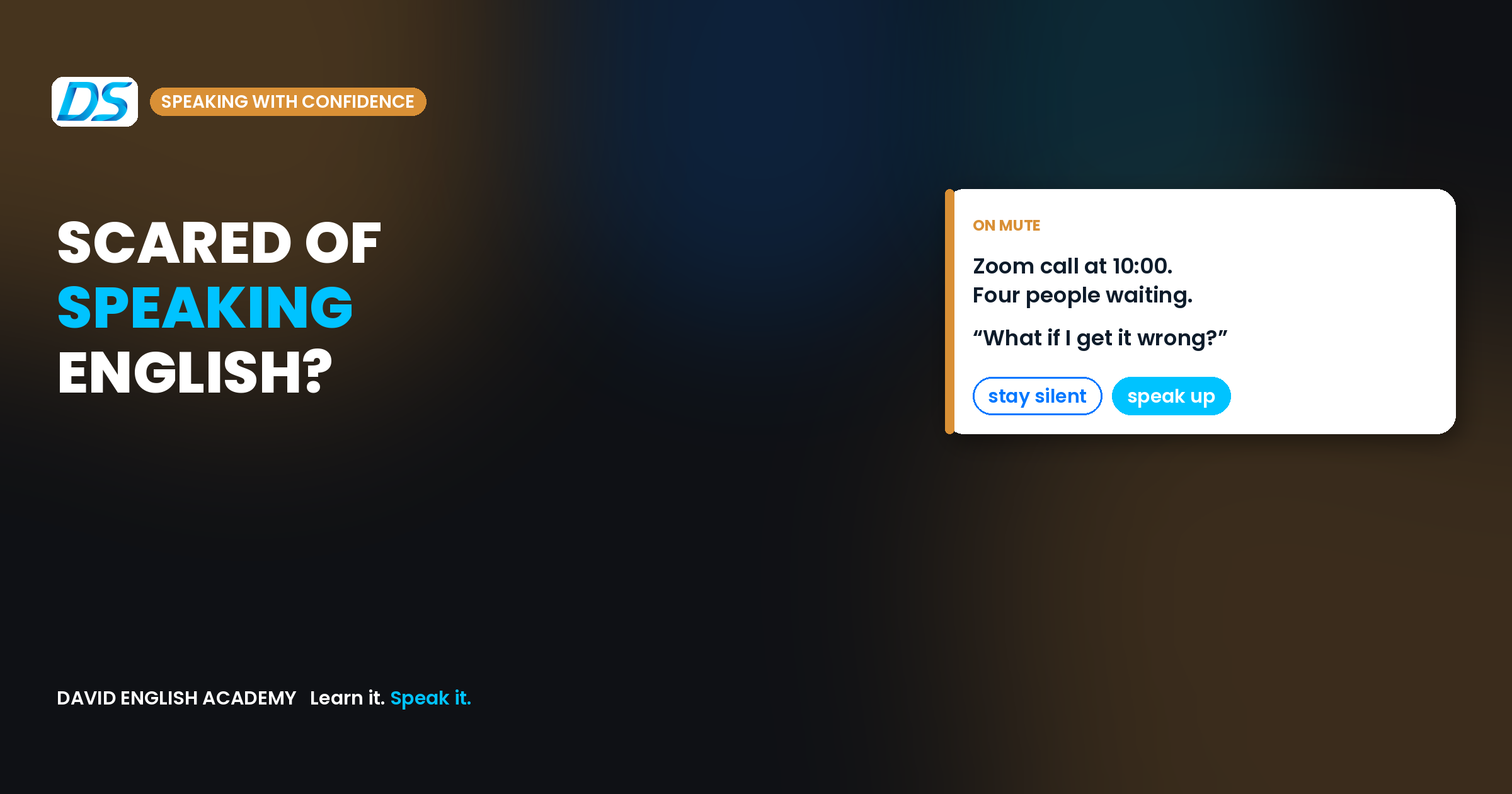
The Zoom invite comes in for tomorrow at 10:00. Four people from the US office. You read the agenda three times. You prepare what you'll say. And then, ten minutes into the call, you still haven't said a word, because every time you're about to speak, a voice in your head says, "What if I get it wrong?"
If that sounds familiar, you're in good company. Most of the professionals I teach can do their job brilliantly. The fear isn't about their ability. It's about English.
The short answer
Fear of speaking English usually comes from one thing: you're trying to be correct before you're clear. The way out isn't to wait until the fear goes away. It's to make speaking smaller and safer, with short, prepared, real situations, until it stops feeling like a test. Confidence comes from doing it many times, not from thinking about it.
Where does the fear actually come from?
From what I see in lessons, it usually comes from a mix of these:
- School English. For many of us, English was something you got marked on. Every mistake was a red circle. So your brain learned that speaking English = being tested.
- Comparing yourself. You compare your English to a native speaker's, or to the colleague who lived abroad. Of course you lose that comparison. It's the wrong one.
- High stakes, low practice. You speak English rarely, and when you do, it's in an important meeting. That's like playing your first football match in a stadium.
- Second-guessing. You build the sentence in your own language, translate it, check the grammar, and by then the conversation has moved on.
None of these mean you're bad at English. They mean you need a different kind of practice.
What does fear sound like at work?
It's not always "I'm scared." It often looks like this:
- You stay on mute and type in the chat instead.
- You say "I agree with Dan" so you don't have to explain your own idea.
- You ask a colleague to "just send the email for both of us."
- You prepare a perfect opening sentence, then can't handle the first follow-up question.
I'm not judging any of this. I've watched very senior people do all four. But each one is a small missed chance to practise, and they add up.
My take: be clear first, correct second
Here's the mindset change I ask every student to make. Your listener doesn't need perfect English. They need to understand you.
"Yesterday I have sent the file" is a mistake. But everybody understands it. "..." (silence) isn't a mistake, and nobody understands it.
So in my lessons, we practise in this order:
- Say it. Get the message out, even if it's simple.
- Make it clear. Is the main point first? Did you say what you need?
- Then make it correct. Now we fix the grammar, one thing at a time.
When you work in that order, the fear has much less to hold onto. You already said the important thing. The rest is polishing.
Four small steps that make speaking feel safer
1. Prepare your first sentence, and your second
Everyone prepares the first sentence. Prepare the answer to the most likely follow-up question too. That's where people freeze.
2. Keep three "safety phrases" ready
- "Sorry, could you say that again?"
- "Just to make sure I understand, you mean...?"
- "Let me think about that and get back to you."
These are professional, polite and completely normal in English meetings. They give you time without silence.
3. Speak first, early
The longer you wait in a meeting, the harder it gets. Say something small in the first five minutes: a question, a short update, even "Good morning, everyone." Once your voice is "in the room", it's much easier to speak again.
4. Practise when it doesn't matter
Talk to the barista in English when you travel. Leave yourself a voice note in English about your day. Small, low-stakes practice is what makes the big moments feel normal.
Mini lesson: choose the word, then the form
Choose the word that fits, then the right form. Say it out loud.
Level 1: Asking someone to repeat
You didn't catch what your colleague said.
Words: say / speak / tell
"Sorry, could you ___ that again?"
Answer: Sorry, could you say that again? (We say words. We tell someone something. "Could you tell me again?" also works, but "say that again" is the most natural.)
Level 2: Checking you understood
Your manager explains a new deadline.
Words: mean / want / need
"Just to make sure I understand, you ___ we should finish by Thursday?"
Answer: Just to make sure I understand, you mean we should finish by Thursday?
Level 3: Buying time
A client asks a question you can't answer yet.
Words: check / get / come
"Good question. Let me ___ with the team and ___ back to you by tomorrow."
Answer: Good question. Let me check with the team and get back to you by tomorrow.
Your turn
Answer these out loud:
Think about the last time you didn't speak in an English meeting or conversation. What did you want to say? Say it now, in two or three sentences. Then tell me: what do you think stopped you?
You just said the thing you didn't say then. That's practice, and that's how the fear gets smaller.
How I teach this when the fear shows up
Fear shrinks when speaking stops feeling like a test. In my lessons you speak from day one, but we keep turns short and winnable. You get a real situation from your work — the Zoom call, the awkward follow-up, the email you keep postponing — and you choose the word that fits that moment, then the form. I correct, coach and build, one pattern at a time. Clear first, correct second.
We practise with timed speaking turns (my JAM method): roughly 60 seconds, then feedback, then a calmer second take. That rhythm trains your mouth and your nerves together. No generic apps — just the English you'll need on Monday.
Mini exercise (right now): Set a timer for 60 seconds. Imagine the next English call on your calendar. Speak out loud: your opening line, one update, and one safety phrase if you need time. When the timer stops, cut anything that sounds like a speech and say a shorter version in 40 seconds.
Your turn: What will you say in the first five minutes of your next English meeting? Speak it once, out loud, as if the camera is already on.
Frequently asked questions
How do I stop being scared of speaking English?
Make speaking smaller and more frequent. Prepare short answers for real situations, learn a few phrases that give you time to think, and speak early in meetings. Fear goes down when speaking stops feeling rare and high-stakes.
Is it OK to make mistakes when speaking English at work?
Yes. Clear English with small mistakes works much better than silence. Focus on getting your main point across first. Accuracy improves with practice and feedback.
Why do I freeze in English meetings but not in my own language?
In your first language you don't think about the language, only the message. In English you're doing both at once: choosing words and grammar while also thinking about the topic. Practising the language part until it feels more automatic frees your mind to think about the message again.
Read next
- I Understand English but Can't Speak It. Why, and How to Fix It
- How Can I Get Fluent in English Fast? An Honest Answer
I'm David Sugarman, founder of David English Academy. Born and raised in New York, I've been teaching English since 2011, and today I teach professionals online around the world. Learn it. Speak it. Read more about me, or visit the homepage to explore the courses.