Why Teams Choose a Native Business English Coach
Apps teach input. Meetings need production. Here's when companies invest in a native business English coach — and what method actually changes client calls.
When a company asks me whether they need a native English coach or "another online course," they're usually already past beginner grammar. Their people can read docs. They can write a passable email. Then a client call starts — and the room goes quiet.
Short answer: teams choose a native business English coach when the goal is real-time speaking for meetings, negotiations and international clients — not another app streak.
The gap apps and grammar courses leave
I see the same pattern with high-tech professionals (including many Hebrew speakers) and with global teams:
- Strong reading, weak spontaneous speaking
- Emails that sound formal but meetings that stall
- Smart engineers who wait for someone else to "take the English part"
A course library helps with input. A coach helps with production under pressure.
What a native coach changes in practice
1. No escape hatch into another language
When the lesson stays in English, your brain practises the same condition as the client call.
2. Natural professional phrasing
Not slang for fun — the moves meetings need:
- "If I can jump in for a second…"
- "I see your point. Here's my concern."
- "Can we align on next steps before we drop?"
3. Feedback on the mistakes that repeat
Apps rarely catch the one structure you misuse every standup. A coach will — and will make you fix it while speaking, not only while typing.
4. Cultural pacing
How long an update should be. When to be direct. How to disagree without sounding like a fight. That coaching is hard to download.
How I teach this (native isn't magic — method is)
Being a native speaker matters for modelling natural English. It isn't enough by itself. What matters is the method:
- Speak from day one
- Practise the English of the real job
- Choose the word that fits the situation, then the form
- Correct, coach and build
- Short timed speaking turns (the JAM method)
I've taught online worldwide since founding my academy after years of classroom and corporate teaching. The teams that improve are the teams that practise speaking about their projects, not imaginary tourist dialogues.
What good corporate coaching looks like (checklist)
When you evaluate a trainer or academy for your team, ask:
- Will people speak in the first lesson about our work?
- Are sessions built on meetings, emails and clients — or generic textbook units?
- How do you measure progress besides attendance?
- Can managers hear samples or see situation scorecards?
- Is there a plan for intensive timelines (expansion, relocation, new global clients)?
If the answers are vague, keep looking.
When a company should invest in coaching
Consider one-on-one or intensive team coaching when:
- Client-facing roles are stuck at "understands but won't speak"
- You're preparing for international expansion or relocation
- Managers need English for leadership, not only email
- You've tried generic apps and the meetings didn't change
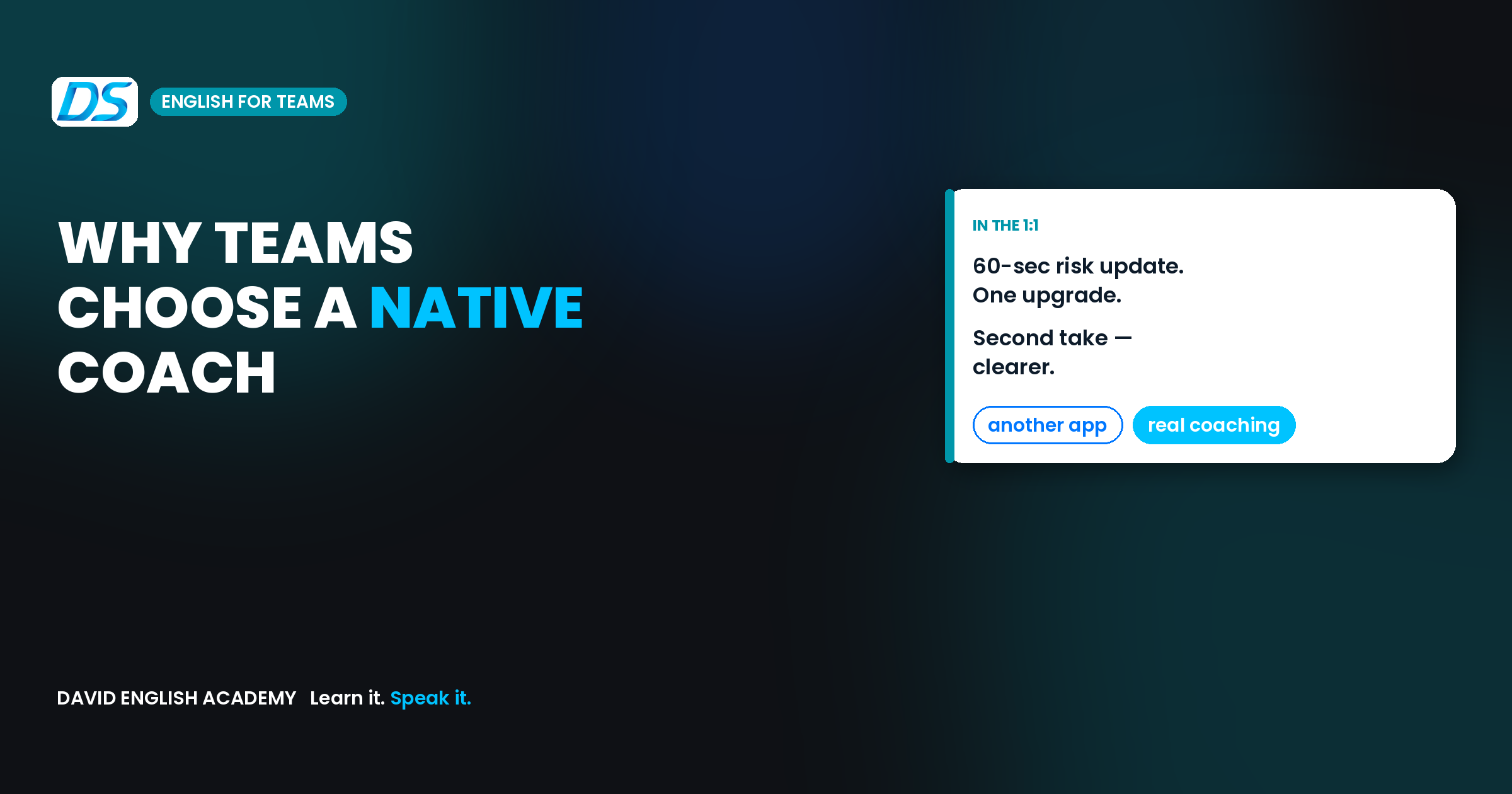
Mini exercise for a team lead (10 minutes in your next 1:1): Ask a team member to explain a current risk in English for 60 seconds. Coach one upgrade (clearer opener, better status word, or softer disagreement). Hear the second take.
Your turn: Write the three English situations your team must handle this quarter. If you can't name them, you can't train them.
Frequently asked questions
Do we only hire native speakers as teachers?
Hire for teaching skill + business English experience. Native speech models help; clear methodology matters more than a passport alone.
Is this only for Israeli high-tech teams?
No. The pattern shows up wherever professionals learned English mainly through reading and tests. I work with learners online worldwide; many of my coaching clients are Hebrew speakers in high-tech because that demand is strong.
Can the team share one group class only?
Group classes help shared vocabulary. Individual speaking time fixes personal blockers faster. Many companies combine both.
Read next
- Getting Your Team Ready for a Move Abroad
- How to Measure Your Team's English Progress (Without Fake Stats)
I'm David Sugarman, founder of David English Academy. Born and raised in New York, I've been teaching English since 2011, and today I teach professionals and teams online around the world. Learn it. Speak it. Read more about me, visit the homepage, or talk to David about training your team.